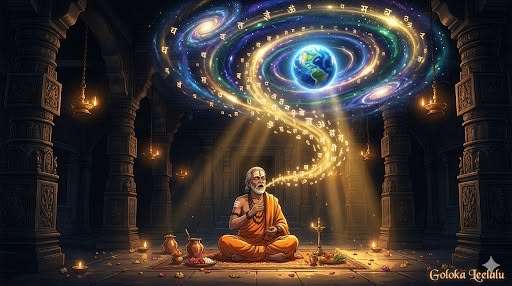
Moksha (also known as Mukti or Nirvana) is the fourth and ultimate goal of human life in Hindu philosophy, surpassing Dharma (duty), Artha (wealth), and Kama (pleasure). It represents the liberation of the individual soul (Atman) from the endless cycle of birth, death, and rebirth (Samsara). Moksha is not merely a post-death destination but a state of supreme consciousness, eternal peace, and unity with the Divine (Brahman) that can be realized even while living.
In Sanatana Dharma, suffering arises from ignorance (Avidya) of our true nature. We mistakenly identify ourselves with the temporary body and mind, leading to desire, fear, and attachment. Moksha is the awakening from this dream of separation. It is the realization that the drop of water (individual soul) has always been part of the ocean (universal consciousness). This guide explores the profound meaning of liberation and the paths to attain it.
Essential Insights
- End of Suffering: Moksha frees the soul from all forms of physical, mental, and emotional pain.
- Not Extinction: It is not becoming nothing; it is becoming everything—realizing one's infinite nature.
- Achievable Now: Liberation is not just for after death; it can be experienced here and now (Jivanmukti).
What Exactly is Moksha?
To understand Moksha, we must look at what it liberates us from and what it leads us to:
Concept: Breaking the Cycle
Explanation: Samsara is the continuous wheel of reincarnation
driven by Karma. As long as we have unfulfilled desires and unresolved karma, we are
bound to take birth again. Moksha stops this wheel, ending the need for further
physical existence.
Concept: Non-Duality (Advaita)
Explanation: The core realization is that the individual self
(Atman) is identical to the universal reality (Brahman). The sense of "I" expands to
include all existence. Separation dissolves into oneness.
Concept: Supreme Peace
Explanation: Moksha is described as Sat-Chit-Ananda
(Truth-Consciousness-Bliss). It is a state beyond happiness and sadness, where the
soul rests in its natural, joyful essence, free from anxiety and fear.
The Four Paths to Moksha
Hinduism offers different yogic paths suited to different temperaments:
- Jnana Yoga (Path of Knowledge): For the intellectual. Uses discernment (Viveka) to distinguish between the real (eternal) and unreal (temporary). Study of scriptures and self-inquiry ("Who am I?") are key.
- Bhakti Yoga (Path of Devotion): For the emotional. Surrenders the ego to God through love, prayer, and service. Seeing the Divine in all beings leads to union.
- Karma Yoga (Path of Action): For the active. Performs duties selflessly without attachment to results. Purifies the heart and reduces egoistic tendencies.
- Raja Yoga (Path of Meditation): For the disciplined. Uses physical and mental control (Asanas, Pranayama, Dhyana) to still the mind and experience inner silence.
Uses intellect to dissolve ignorance and realize the Self.
Uses love and surrender to merge with the Divine.
Uses selfless action to purify the mind and ego.
Jivanmukti: Liberation While Living
A unique concept in Hinduism is Jivanmukti:
- Definition: A person who has attained Moksha while still in the physical body.
- Characteristics: They continue to live and work but are no longer bound by karma. They act out of compassion, not desire.
- State of Mind: Equanimity in success and failure, pleasure and pain. They see the same Divine presence in everyone.
- Examples: Saints like Ramana Maharshi, Swami Vivekananda, and Ramakrishna Paramahansa are considered Jivanmuktas.
"Moksha is not going somewhere else. It is waking up to where you already are. It is realizing that you were never bound, only dreaming that you were."
Common Misconceptions about Moksha
Clarifying doubts about liberation:
- "It means becoming nothing": False. It means becoming everything. The limited "small self" disappears, but the infinite "True Self" remains.
- "Only monks can attain it": False. Householders like King Janaka and Arjuna attained high states of consciousness while fulfilling their duties.
- "It is selfish": No. A liberated being radiates peace and compassion, helping others indirectly by their very presence.