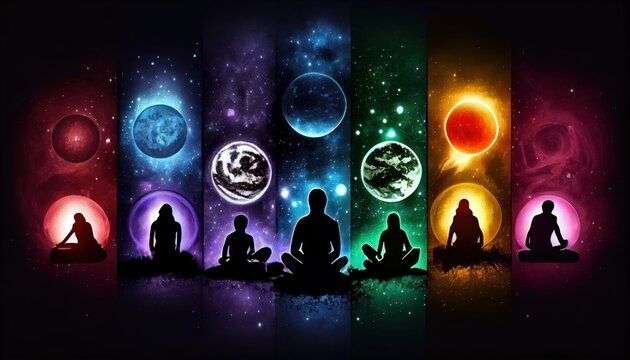
At the heart of Hindu philosophy lie three interconnected concepts that explain the nature of existence: Karma (action and consequence), Dharma (cosmic order and duty), and Rebirth (the continuous journey of the soul). Together, they form a comprehensive framework that answers fundamental questions: Why do we suffer? What is our purpose? And what happens after death?
Unlike linear views of life, Sanatana Dharma sees existence as a vast, cyclical process. The soul (Atman) is eternal, taking on various bodies to learn, evolve, and eventually realize its divine nature. Understanding these laws empowers individuals to take responsibility for their lives, act with integrity, and navigate challenges with wisdom rather than despair. This guide breaks down these profound concepts into clear, actionable insights.
Essential Insights
- Law of Cause and Effect: Karma is not punishment or reward, but a neutral natural law like gravity.
- Moral Compass: Dharma provides the ethical guidelines to generate positive Karma.
- Soul's Evolution: Rebirth is an opportunity for the soul to complete its learning and achieve liberation.
Defining the Core Concepts
Let's explore each concept in detail:
Meaning: Literally "action" or "deed."
Explanation: Every action—physical, verbal, or mental—creates an
impression (Samskara) that yields future results. Good actions lead to positive
outcomes; harmful actions lead to suffering. Importantly, it is the
intention behind the action that determines the karmic weight. Karma
operates across lifetimes, explaining why good people sometimes suffer (past karma)
and bad people prosper (pending consequences).
Types: Sanchita (accumulated), Prarabdha (current life), and Agami
(future).
Meaning: That which sustains; righteousness.
Explanation: Dharma is the moral code that maintains harmony in the
universe. It is context-specific: the dharma of a student is to study, while the
dharma of a warrior is to protect. Following Dharma minimizes negative Karma and
aligns individual will with cosmic will. It is not rigid rules but flexible
principles of truth, non-violence, and responsibility.
Meaning: Transmigration of the soul.
Explanation: The body dies, but the soul is immortal. Based on
accumulated Karma, the soul takes a new birth in a suitable environment to learn
remaining lessons. This cycle continues until the soul achieves Moksha (liberation).
Rebirth explains inequalities in birth, talents, and circumstances as results of
past-life actions.
The Cycle of Samsara
These three concepts create the cycle of Samsara:
- Action (Karma): We act based on our desires and ignorance.
- Consequence: Actions create bonds and impressions.
- Birth (Rebirth): To experience these consequences, the soul takes a new body.
- Learning: Through life experiences, the soul evolves.
- Liberation (Moksha): When all lessons are learned and karma exhausted, the cycle ends.
Future karma created by current actions. We have full control over this.
Current life karma. We must experience this, but can choose our reaction.
Total accumulated karma from all past lives. Reduced through wisdom.
"You are not a drop in the ocean. You are the entire ocean in a drop. Your karma is just the ripple you create; your dharma is the tide that brings you home."
How to Break the Cycle
The goal of Hindu spirituality is to exit the cycle of rebirth:
- Nishkama Karma: Perform duties without attachment to results. This stops the creation of new binding karma.
- Jnana (Knowledge): Realize that you are the soul, not the body. Ignorance is the root of bondage.
- Bhakti (Devotion): Surrender to the Divine. Grace can dissolve even heavy karma.
- Dharma: Living righteously ensures that future births are favorable for spiritual progress.
Common Misconceptions
Clarifying doubts about these laws:
- "Karma is Fate": False. While Prarabdha is fixed, Agami is in your hands. You are the architect of your future.
- "Rebirth means becoming an animal": Not necessarily. Most rebirths are human. Animal births are rare and usually for specific instinctual lessons.
- "Dharma is rigid": No. Dharma changes with time, place, and person. What is right for a king may not be right for a monk.