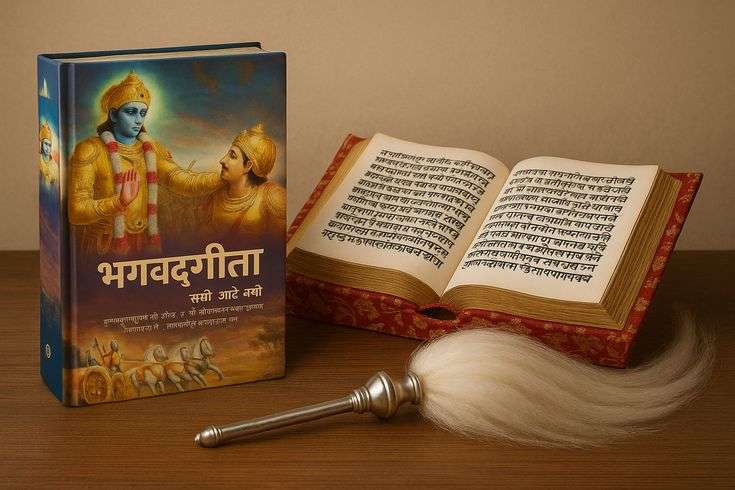
The Bhagavad Gita, meaning "Song of God," is a 700-verse Hindu scripture that forms part of the epic Mahabharata. It consists of a dialogue between Prince Arjuna and Lord Krishna, who serves as his charioteer and spiritual guide. Set on the battlefield of Kurukshetra, this sacred text addresses fundamental questions about duty, righteousness, devotion, and the nature of reality.
Divided into 18 chapters, each focusing on different aspects of yoga and philosophy, the Gita presents a comprehensive guide to spiritual life. From the initial moral dilemma to the ultimate revelation of divine consciousness, these chapters take readers on a transformative journey from confusion to clarity, from attachment to liberation.
Essential Insights
- Three Paths: The Gita presents Karma Yoga (action), Jnana Yoga (knowledge), and Bhakti Yoga (devotion) as paths to liberation.
- Practical Wisdom: Teachings apply not just to spiritual seekers but to anyone facing life's challenges and dilemmas.
- Universal Message: While rooted in Hindu tradition, its wisdom transcends religious boundaries and speaks to all humanity.
All 18 Chapters Summarized
Here is a concise summary of each chapter in the Bhagavad Gita:
Title: The Yoga of Arjuna's Dejection
Verses: 47
Summary: Arjuna surveys the battlefield and sees his relatives,
teachers, and friends on both sides. Overwhelmed by grief and moral confusion, he
refuses to fight, questioning the value of victory if it means killing loved ones.
This chapter sets up the central dilemma that Krishna will address.
Title: The Yoga of Knowledge
Verses: 72
Summary: Krishna begins his teachings by explaining the eternal
nature of the soul (atman). He introduces key concepts: the soul is immortal, the
body is temporary, and one must perform duty without attachment to results. Contains
the famous verse on performing action without desire for fruits (Karma Yoga
foundation).
Title: The Yoga of Action
Verses: 43
Summary: Krishna elaborates on selfless action. He explains that
everyone must act according to their nature and duty, but should do so without ego
or attachment. Inaction is not the solution; rather, action performed with the right
attitude leads to liberation. Introduces the concept of Yajna (sacrifice) as the
basis of cosmic order.
Title: The Yoga of Knowledge and Renunciation of Action
Verses: 42
Summary: Krishna reveals the ancient lineage of this knowledge and
explains how he incarnates age after age to restore dharma. He describes different
types of sacrifices and emphasizes that knowledge burns away karma. True
renunciation is not abandoning action but abandoning attachment to results.
Title: The Yoga of Renunciation
Verses: 29
Summary: Krishna clarifies the relationship between action and
renunciation. Both the path of action (Karma Yoga) and the path of renunciation
(Sannyasa) lead to the same goal when practiced correctly. A true yogi sees all
beings equally and remains undisturbed by pleasure or pain.
Title: The Yoga of Meditation
Verses: 47
Summary: Detailed instructions on meditation practice. Krishna
describes the ideal meditator, proper posture, mental discipline, and techniques for
controlling the mind. He acknowledges that the mind is restless but assures that
through practice and detachment, it can be mastered. Even failed yogis get another
chance in future lives.
Title: The Yoga of Knowledge and Realization
Verses: 30
Summary: Krishna explains his divine nature and how he pervades all
creation. He describes four types of devotees and reveals that few truly know him in
his entirety. Everything in existence rests upon him like pearls on a string.
Understanding this supreme truth liberates one from the cycle of birth and death.
Title: The Yoga of the Imperishable Brahman
Verses: 28
Summary: Krishna explains the nature of Brahman (ultimate reality),
Adhyatma (individual soul), and Karma (action). He describes what happens at death
based on one's consciousness and explains the two paths: the path of light leading
to liberation and the path of darkness leading to rebirth. Constant remembrance of
God at death ensures liberation.
Title: The Yoga of Royal Knowledge and Royal Secret
Verses: 34
Summary: Krishna reveals the most confidential knowledge: he
accepts offerings from all devotees regardless of what they offer, as long as it's
given with love. He explains how he creates, maintains, and dissolves the universe
while remaining detached. Even the greatest sinners can attain liberation through
sincere devotion.
Title: The Yoga of Divine Glories
Verses: 42
Summary: Krishna describes his various manifestations and opulences
throughout creation. He is the source of all powers, qualities, and excellences
found in beings. Arjuna requests to know more about Krishna's divine forms, leading
to the next chapter's revelations. Recognizing divinity in all things transforms
perception.
Title: The Yoga of the Vision of the Universal Form
Verses: 55
Summary: At Arjuna's request, Krishna reveals his cosmic form
(Vishvarupa)—a terrifying and magnificent vision containing all universes, beings,
and time itself. Arjuna witnesses past, present, and future simultaneously.
Overwhelmed, he requests Krishna to return to his gentle form. This chapter
demonstrates Krishna's supreme divinity.
Title: The Yoga of Devotion
Verses: 20
Summary: Krishna explains the superiority of devotional service
over other spiritual practices. He describes the qualities of an ideal devotee: free
from hatred, compassionate, humble, patient, and equipoised. While knowledge and
austerity have their place, pure love and devotion are the easiest and most direct
path to God.
Title: The Yoga of Distinction Between Field and Knower of Field
Verses: 35
Summary: Krishna distinguishes between the body (field/kshetra) and
the soul (knower of field/kshetrajna). He lists twenty factors that constitute
knowledge and explains Prakriti (nature) and Purusha (consciousness). Understanding
this distinction leads to liberation from material bondage.
Title: The Yoga of the Division of Three Gunas
Verses: 27
Summary: Detailed explanation of the three modes of material
nature: Sattva (goodness), Rajas (passion), and Tamas (ignorance). Krishna describes
how each mode binds the soul, their characteristics, and how to transcend them. One
who rises above all three modes attains liberation and realizes Brahman.
Title: The Yoga of the Supreme Person
Verses: 20
Summary: Krishna uses the metaphor of an inverted banyan tree to
describe material existence. He explains the difference between perishable beings,
imperishable souls, and the Supreme Person (Purushottama) who transcends both.
Knowing Krishna as the Supreme Person leads to complete surrender and liberation.
Title: The Yoga of Division Between Divine and Demoniac Natures
Verses: 24
Summary: Krishna contrasts divine qualities (fearlessness, purity,
charity, humility) with demoniac qualities (pride, anger, ignorance, hypocrisy). He
explains how these tendencies determine one's destiny and describes three types of
faith corresponding to the three modes. Cultivating divine qualities leads to
liberation.
Title: The Yoga of the Division of Threefold Faith
Verses: 28
Summary: Krishna explains how faith, food, sacrifice, austerity,
and charity are classified according to the three modes. Sattvic practices promote
purity and clarity, Rajasic practices drive ambition and desire, while Tamasic
practices lead to ignorance and delusion. One should gradually elevate from lower to
higher modes.
Title: The Yoga of Liberation through Renunciation
Verses: 78
Summary: The longest chapter synthesizes all previous teachings.
Krishna explains true renunciation, the three types of knowledge, action, and doer.
He concludes with the essence of the Gita: surrender completely to him with love and
devotion. Arjuna's delusion is destroyed, and he agrees to fight. This chapter is
the culmination of Krishna's message.
Core Teachings of the Gita
Beyond individual chapters, the Bhagavad Gita presents several universal principles:
- Duty Without Attachment: Perform your prescribed duties without being attached to success or failure. This is the essence of Karma Yoga.
- Equality of Vision: See the same divine presence in all beings—friend or foe, rich or poor, learned or ignorant.
- Control of Mind: The mind can be either your greatest friend or worst enemy. Through practice and discipline, it can be trained.
- Devotion Supreme: While knowledge and action are valuable, pure love and devotion to God is the highest path.
- Eternal Soul: The soul never dies; only the body perishes. Understanding this removes fear of death.
"Whenever dharma declines and adharma prevails, I manifest myself on earth. To protect the righteous, to destroy the wicked, and to reestablish the principles of dharma, I appear millennium after millennium." — Krishna (Chapter 4, Verses 7-8)
Who Should Read the Bhagavad Gita?
The Bhagavad Gita offers wisdom for everyone:
- Students: Learn focus, discipline, and how to handle exam pressure without anxiety.
- Professionals: Understand how to work efficiently while maintaining inner peace and ethical standards.
- Leaders: Gain insights into decision-making under pressure and leading with wisdom rather than ego.
- Spiritual Seekers: Explore multiple paths to liberation and find the one suited to your nature.
- Anyone Facing Crisis: Like Arjuna, we all face moments of confusion. The Gita provides clarity and courage.