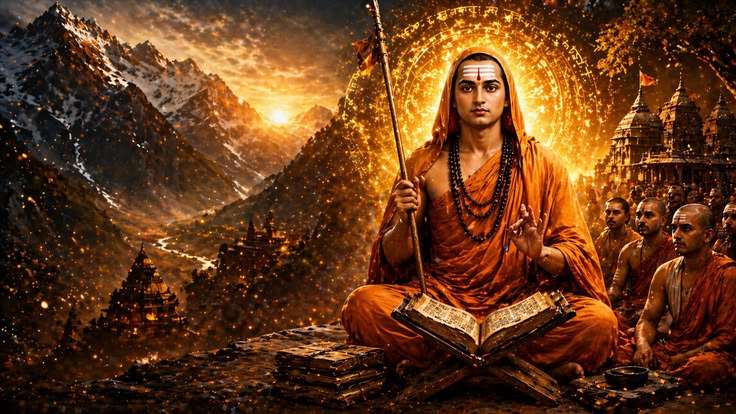
The Upanishads are the philosophical crown jewels of Vedic literature, composed between 800-200 BCE. The word "Upanishad" means "sitting near"—referring to disciples sitting close to a guru to receive secret teachings. Unlike the ritual-focused earlier Vedas, the Upanishads shift focus inward, exploring the nature of the self (Atman), ultimate reality (Brahman), and the path to liberation (Moksha).
There are over 108 Upanishads, but ten are considered principal (Mukhya Upanishads): Isha, Kena, Katha, Prashna, Mundaka, Mandukya, Taittiriya, Aitareya, Chandogya, and Brihadaranyaka. These texts form the foundation of Vedanta philosophy and have influenced thinkers worldwide, from Schopenhauer to Einstein. Their teachings are not dogmatic rules but invitations to inquire deeply into the nature of existence.
Essential Insights
- Self-Inquiry: The primary method is asking "Who am I?" to peel away layers of identity and discover the true Self.
- Non-Duality: Ultimate truth is that individual soul (Atman) and universal consciousness (Brahman) are one.
- Beyond Rituals: External ceremonies are secondary; internal realization through knowledge and meditation is primary.
Core Teachings of the Upanishads
The Upanishads present several revolutionary concepts that define Hindu philosophy:
Concept: Identity of Individual and Universal
Explanation: The core teaching is that your true self (Atman) is
not different from the ultimate reality (Brahman). Just as space inside a jar is the
same as space outside, the individual consciousness is identical to universal
consciousness. Realizing this unity is liberation.
Concept: The Veil of Appearance
Explanation: The world we perceive through senses is not ultimately
real—it is Maya, a cosmic illusion superimposed on Brahman. Like seeing a rope as a
snake in dim light, we mistake the transient world for permanent reality. Wisdom
means seeing through this illusion.
Concept: Waking, Dreaming, Deep Sleep, and Turiya
Explanation: The Mandukya Upanishad describes four states: Jagrat
(waking), Dreama (dreaming), Sushupti (deep sleep), and Turiya (pure consciousness).
Turiya is the witness state beyond all three, representing our true nature as pure
awareness.
Concept: Method of Negation
Explanation: To know the Self, you must negate everything it is
not. "I am not the body, not the mind, not the emotions, not the ego." By stripping
away all temporary identifications, what remains is the eternal Atman. This is a
powerful meditative technique.
Concept: Law of Cause and Effect
Explanation: Actions create impressions (samskaras) that shape
future experiences. The soul takes birth repeatedly until it realizes its true
nature. Liberation (Moksha) means breaking free from this cycle by extinguishing
desire and ignorance.
Concept: Guidance from Enlightened Teacher
Explanation: The Upanishads emphasize that self-knowledge cannot be
gained solely from books. A realized Guru is essential to point out the truth
directly. The relationship between Guru and disciple is sacred, based on humility,
surrender, and sincere inquiry.
The Mahavakyas (Great Sayings)
Four powerful statements encapsulate the essence of Upanishadic wisdom:
- "Tat Tvam Asi" (Chandogya Upanishad): "Thou Art That." You are not separate from the ultimate reality. Your true nature is divine.
- "Aham Brahmasmi" (Brihadaranyaka Upanishad): "I Am Brahman." The individual self is none other than the universal consciousness.
- "Ayam Atma Brahma" (Mandukya Upanishad): "This Self is Brahman." The innermost core of your being is identical to the absolute.
- "Sarvam Khalvidam Brahma" (Chandogya Upanishad): "All This Is Indeed Brahman." Everything in existence is a manifestation of the one divine reality.
"The Upanishads are not theology—they are direct experiences of truth recorded by sages who dared to look within. They invite you not to believe, but to verify."
Highlights from Major Upanishads
Each principal Upanishad offers unique insights:
- Katha Upanishad: Uses the story of Nachiketa and Yama (Death) to teach that the Self is beyond birth and death. Contains the famous chariot analogy: body is the chariot, senses are horses, mind is reins, intellect is driver, and Self is the passenger.
- Mundaka Upanishad: Distinguishes between lower knowledge (rituals, sciences) and higher knowledge (Self-realization). Uses the analogy of two birds on a tree—one eating fruits (engaged in world), the other watching silently (witness consciousness).
- Chandogya Upanishad: Teaches "Tat Tvam Asi" through the story of Svetaketu. Emphasizes that truth is subtle and requires refined perception. Contains instructions on Om meditation.
- Brihadaranyaka Upanishad: The longest and oldest Upanishad. Explores creation, the nature of desire, and the identity of Atman and Brahman. Famous for Yajnavalkya's dialogues with his wife Maitreyi.
- Isha Upanishad: Short but profound. Teaches seeing the divine in all beings and balancing action with renunciation. "Whatever moves in this moving world is pervaded by the Divine."
Practical Application Today
Upanishadic wisdom is highly relevant for modern life:
Understanding you are not the mind reduces anxiety and stress significantly.
Seeing divinity in all beings naturally fosters empathy and kindness.
Distinguishing real from unreal helps make better life decisions.